
Muncie Mayor Announces Community Center Replacement Will Be Outside of Industry Neighborhood
7.29.2026 / News / Daisy Dale
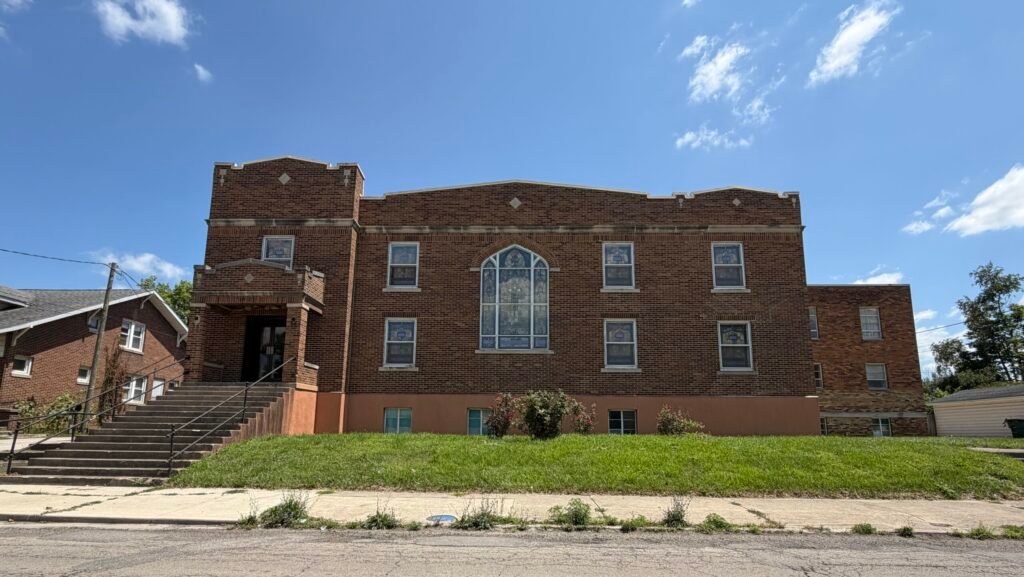
Former Industry United Methodist Church that Muncie Mayor Dan Ridenour wants the center located. 1910 S. Mock Ave.
Correction: According to multiple people who attended the last Community Center Advisory Committee meeting, Dan Ridenour was incorrect that a formal vote was made on the location of the center.
MUNCIE, Ind. — On Tuesday July 28, Muncie Mayor Dan Ridenour announced that the long awaited replacement of the South Madison Community Center, also known as the “Multi,” will not be located in Industry neighborhood. After the 1910 S. Mock Ave location, formerly Industry United Methodist Church, became the only choice by the city, a committee for making recommendations for the new center “voted” in favor according to Ridenour.
Since July of last year, a portion of Heekin Park had been considered for a new location, but after the City of Muncie obtained the 1910 S. Mock Ave location, it will be now used for the center. Meetings by the committee have been held at the same location, and earlier this year $500k was appropriated for the community center through EDIT (Economic Development Income Tax) funding.
The City of Muncie in a Facebook comment decided to point out a low attendance at the last committee meeting, and complained that the dissenting vote came from Muncie City Councilman William McIntosh, who also serves on the committee. According to Councilmember Harold Mason, there was no formal vote made but only a discussion. Ridenour said he was glad the committee “saw the bigger picture” and were in favor, and added that he believed he was the first mayor to help get the community center back.
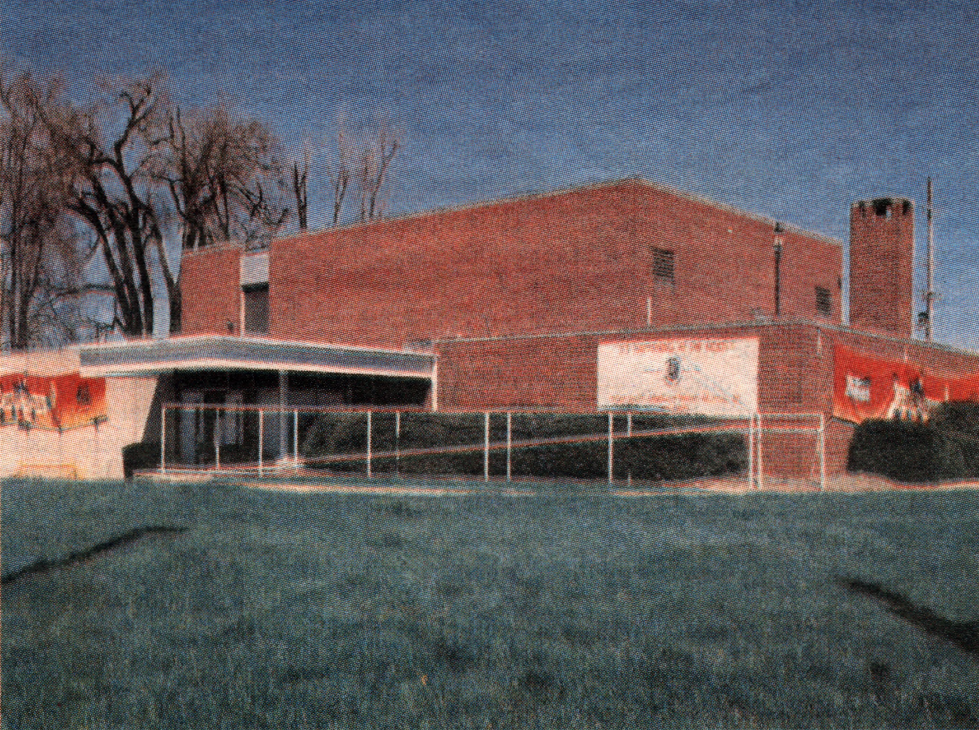
South Madison Community Center circa 2006. From Muncie Times, April 20, 2006.
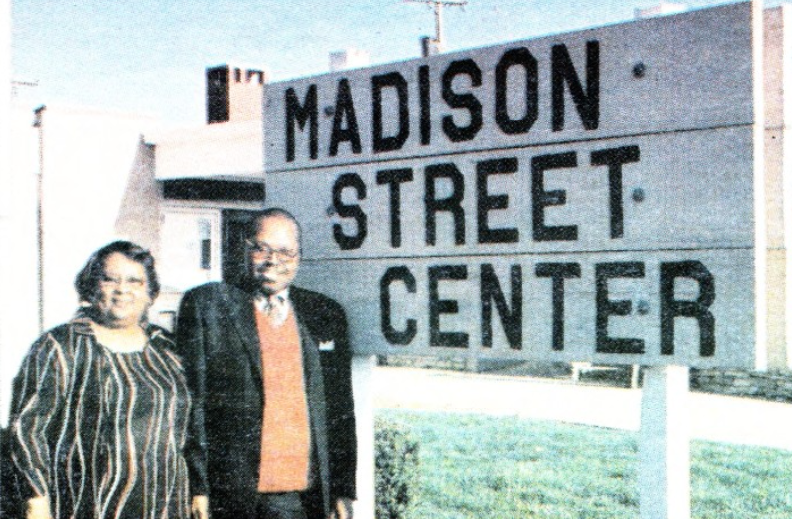
Dorothy Harris (left) and Demetrius Dee Harris (right). From Muncie Times, April 20, 2006. p. 13.
The original South Madison Community Center was demolished in 2006. Ever since a 2002 Hope VI Grant had homes nearby demolished, including the original 900 S. Madison St. location, the long-awaited promise of bringing a new community center to Industry neighborhood has been an ongoing headache for two decades.
While the building itself started as a YMCA location in the ’60s, its story goes back to 1921 when the first efforts were made to organize a YMCA for Muncie’s Black community. The first known meeting was September 5, 1921 at the Antioch Baptist Church led by Reverend Martin Coleman. Between then and until the ’40s, programs had to be hosted out of various spaces before the grounds of a former Jackson School was purchased in 1946.1
Then the South Madison building itself first opened as a new “Y” location on November 8, 1964, and carries a rich history. Roy C. Buley, famous for his role in the desegregation of Tuhey Pool, had served as an executive director early on.2 In 1975 the downtown “Y” building, 500 S Mulberry St, was built, and the following year the Madison Street location became a city owned community center.3 Over the years it was referred to as “the Multi,” but officially got the name “Multi-Service Center” in 1982.4
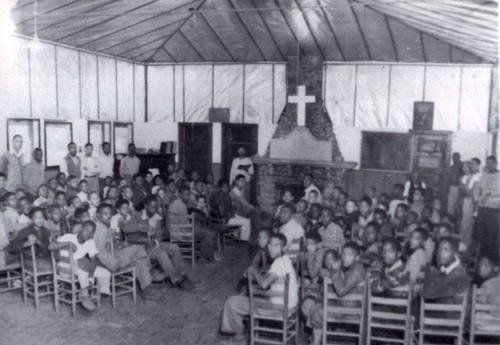
“African American branch of the Muncie YMCA interior” from 1948. From BSU DMR.
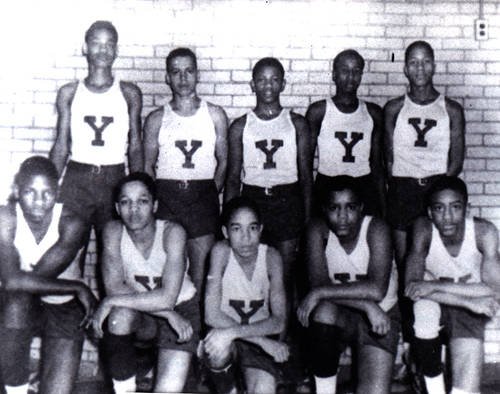
“Muncie African American Branch of YMCA basketball team” from 1948. From BSU DMR.
It also became a hub for social activism, as leaders of Industry neighborhood including Rev. J.C. Williams and Alice McIntosh-Kelly were highly influential, and at times Muncie Human Rights Commission meetings would be hosted at the center. A sociologist visiting Muncie in 1980 recalled in his journal “one of the young youth workers at the Multi-Purpose Center on South Madison had said that whites did not want blacks to have the multi-service center, but the community rose up in protest. There seems to be an undercurrent of bitterness carried into the present that resulted from past actions that may be unacknowledged or denied?”5
In 1996, then-Mayor Dan Canan discontinued city ownership of community centers, and the Multi had to rely on non-governmental organizations to remain standing.6 Demetrius Dee Harris served as an executive director starting in 1997, and by many accounts he brought the center to a new level in its last decade. Jasmine Taylor, one of the members of the new advisory committee, called the center “an asset to all the youth in the area, to families, to seniors. It was the only thing the Industry neighbors had that was really something positive and a safe haven and place for kids to go.”7
The original Hope VI grant demolishing the center ensured that a replacement would be built, with $343k in funding appropriated, but it remains unclear what happened to the funding. There was a Unity Center, opened in 2014 after long awaited talks starting just after the Multi’s demolition, that was intended to combine programming for the former Multi and Muncie Boys & Girls Club. The Unity Center lost its building on June 15, 2017, yet the financial reasons are unclear. Advocate for the center Carl Malone told the Star Press in 2017 that nobody knew where the funding that was earmarked went.
The committee established last year, called the Community Center Advisory Committee, has had its own hiccups since being formed. Mayor Ridenour once had Industry neighborhood representative Jasmine Taylor removed and replaced by Parks Department Superintendent Carl Malone, before changing the decision. Lezlie McCrory from South Central Neighborhood had left the committee in frustration with the direction the city was taking it. A council representative was supposed to be voted on by the council, however Council President Jeff Green decided to join before a vote could be made. That decision would be reversed with a formal vote from council, and Councilor William McIntosh was voted unopposed and unanimously.
Daisy Dale is the editor and publisher of The Muncie Post-Democrat, a commissioner for the Muncie Human Rights Commission, and a board member of Muncie Queer Alliance.
Notes:
1. “Why the ‘Y’: A Short Composite Picture and History of the Madison Street Branch Y.M.C.A.” Young Men’s Christian Association. Muncie, Indiana. pp. 1-3. https://archivessearch.bsu.edu/repositories/5/archival_objects/8128; Goodall, Hurley C. “South Madison’s future tied to its history, fight for a nonracial Muncie.” Muncie Times. December 9, 2004. p. 9. https://newspapers.library.in.gov/?a=d&d=BALLMT20041209-01.1.9&e=——-en-20–1–txt-txIN——-
2. Goodall, Hurley C. “Those Who Made a Difference Volume 1.” Muncie Public Library. 2003.
3. Lake, Jeannine Lee. “Welcome to ‘The Multi.’” Star Press. May 16, 2000. http://www.newspapers.com/image/249162298/. p. 7; “Muncie Parks and Recreation Master Plan, December 1998.” The City of Muncie. 1998. p. 72.
4. Lake, “Welcome to ‘The Multi,’” p. 7.
5. Dennis, Rutledge. Finding the African Americans That Middletown Left Out: The Field Notes of a Sociologist. Edwin Mellen Press, 2012. p. 54.
6. Lake, “Welcome to ‘The Multi,’” p. 7.
7. Interview with Jasmine Taylor. April 26, 2026.