
A. Philip Randolph and the First Red Scare
6.19.2026 / Essay / Daisy Dale
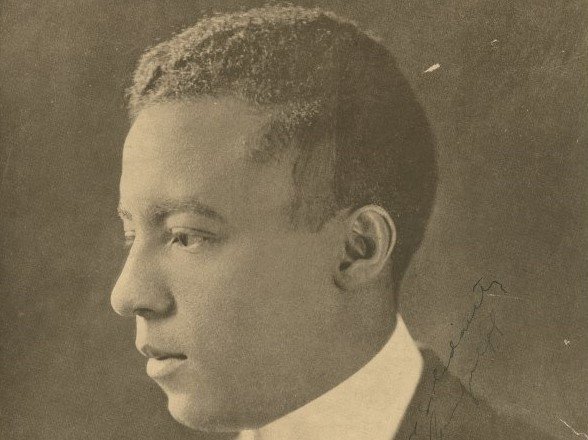
“Salvation for a race, nation, or class must come from within. Freedom is never granted; it is won. Justice is never given; it is exacted. Freedom and justice must be struggled for by the oppressed of all lands and races, and the struggle must be continuous, for freedom is never a final fact, but a continuing evolving process to higher and higher levels of human, social, economic, political and religious relations.” ~ A. Philip Randolph
“Salvation for a race, nation, or class must come from within. Freedom is never granted; it is won. Justice is never given; it is exacted. Freedom and justice must be struggled for by the oppressed of all lands and races, and the struggle must be continuous, for freedom is never a final fact, but a continuing evolving process to higher and higher levels of human, social, economic, political and religious relations.” ~ A. Philip Randolph
Asa Philip Randolph was the most well accomplished Black trade unionist of the 20th century, if not the entirety of U.S. history. Most known today for his role in organizing the March on Washington in 1963, his career spanned from the 1910s to the late 1960s and had various challenges era by era. He initially started his role as a labor leader very early on, however met success as an organizer with the Brotherhood of Sleeping Car Porters (BSCP) beginning in the mid-1920s. The Black-led union gave Pullman porters better opportunities for a middle class life, and as the Pullman Company was the largest employer of Black Americans by the ’20s, it was a precedent time for the union to be formed.1
Through Randolph’s first attempt of a March on Washington in 1941, planned as a gathering of 10,000 Black Americans, he negotiated with Franklin Roosevelt to pass Executive Order 8802 that ended discrimination in the defense industry. While the march itself never took place, the landmark executive order became a compromise between Randolph and Roosevelt, who was frightened by the prospect of the mass protest against racist practices. Later under Harry Truman’s presidency, Randolph used his political influence to bring an end to military segregation.
Over twenty years later, the 1963 March on Washington totaled over 250,000 attendees, despite the original estimate of half when it was being organized. Before and following the monumental event, he was recognized for his mentorship of civil rights leader and organizer of the march Bayard Rustin, who considered him to be “the Father of the Civil Rights Movement,”2 and worked with him to establish the A. Philip Randolph Institute in 1965. When Rustin discovered the news of his death on May 16th, 1979, he was giving testimony to Congress on the situation of Africa, and broke down after a note was slipped to him with the news.3
Randolph’s career was fundamentally radical, though had moments of compromise-minded strategy. For example, he attempted to work with the American Federation of Labor (AFL), which was infamous for allowing unions under its umbrella to continue racist practices, and successfully got the BSCP a charter with the organization. Randolph effectively broke grounds in doing so, and gained footing in the U.S. labor movement, but to an extent had to acquiesce when he made moves like this. And looking at his body of work overall begs the question: did he operate under liberation or class compromise?
On top of this, every decade saw a different set of challenges for Randolph, and early in his career he faced the repression of the U.S. Red Scare. As an avowed socialist himself, he faced prison time for speaking out against WWI. Both the Espionage Act and the Sedition Act kept Randolph and leaders like Eugene Debs at continual risk of legal persecution, but for Black activists this was combined with the threat of lynchings and an even greater perception of “subversiveness” both for labor radicalism and fighting against white supremacy. Charisse Burden-Stelly’s 2023 book Black Scare / Red Scare: Theorizing Capitalist Racism in the United States explores the relationship between anti-Black and anti-radical repression between the post-WWI years and the McCarthy-Era. As Burden-Stelly characterizes it:
“Ordinary citizens, especially those in the middle and upper classes, developed fear and anxiety about labor and racial radicalism, not least when it seemed to challenge the idea that rights and privileges were reserved primarily for those who ‘play[ed] the game respectably’ and patiently worked for them. Likewise, from World War I onward, everyday Americans conflated nativism, xenophobia, and racism with the idea that radicalism was alien influenced and the struggle for equal rights was the product outside–namely, communist–agitation.”4
Less than a decade before, as many Black Americans were moving from the South to the Industrial North, Randolph moved from Jacksonville, Florida to New York City in 1911. While attending City College of New York, he delivered soapbox orations in Harlem. When police presence at the site of their orations grew, Randolph decided he would start talking about “the oppression of Irish people by the British imperialism” anytime he would see an officer and the police would leave the crowd alone. Then Randolph would go back to topics of racial discrimination and socialism.5
Randolph starting his writing career when he met Chandler Owen and initially started The Hotel Messenger, but after a dispute with a financier changed it to The Messenger, and it was in this period of his activism that he was deemed “the most dangerous Negro in America” by Attorney General A. Mitchell Palmer.
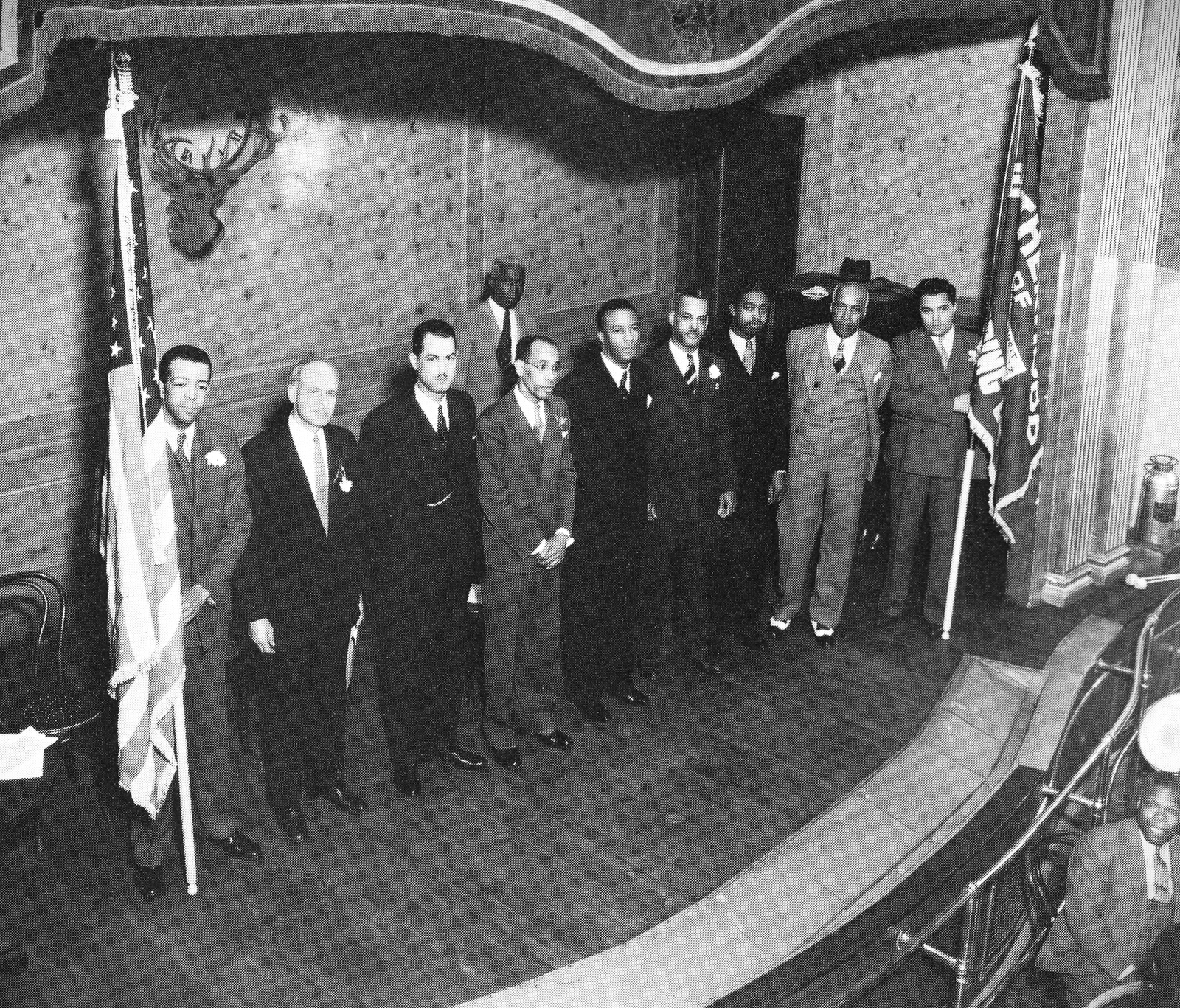
Randolph and other leaders of the Brotherhood of Sleeping Car Porters at Harlem’s Elks Hall in 1925. Picture from Daniel Davis’ “Mr. Black Labor.”
The Messenger was regarded as “the heart of Harlem’s socialist community,”6 and contained many well known names from the literature and poetry of the Harlem Renaissance. In a time when many radical labor papers were forced to cease publication, Randolph held stronger support for the radical International Workers of the World (IWW) than the AFL, whose founder Samuel Gompers he considered a “conservative, reactionary and chief strikebreaker.”8 In his pacifist opposition to WWI, he labelled it “the imperialist struggle” and called for protest through civil disobedience.9 Besides the Messenger, he formed the Friends of Negro Freedom (FNF) union and ran unsuccessfully for state comptroller in 1920, and secretary of state in 1921.10
The most publicized event to happen in this time was his rift with Marcus Garvey, founder of the Universal Negro Improvement Association (UNIA) that once had 4.5 million dues paying members. Garvey, a Pan-Africanist and Black Nationalist leader who would later be influential to Malcolm X and Martin Luther King Jr. among others, was admired by Randolph earlier on and was even invited by him to give his first lecture in the U.S.11 Ideologically, the difference came down to Randolph’s interracial labor militancy versus Garvey’s Black separatism, as Garvey was seeking to start a pan-African empire.
In June of 1922, Garvey visited the Ku Klux Klan’s headquarters in Atlanta, Georgia, where he secretly met with Imperial Wizard Edward Young Clarke. Garvey defended the act by insisting he had a “higher regard for the man who intends to take my life, who will warn me… rather than the man who pretends to be my friend and ushers me into eternity.” Randolph would join other Black leaders in calling for his deportation through the “Garvey Must Go” campaign. In September of that year, Randolph was sent a severed Black hand in the mail with a letter attached signed “K.K.K,” and in his correspondence with the FBI following the incident claimed it was possible that a Garvey supporter had in fact sent it, and recalled a recent speech by Garvey where he said he would “not be responsible if Randolph or Owen lost a hand or a foot.”12 Garvey in February 1925 would be convicted and imprisoned for mail fraud before being deported in 1927. Ultimately, despite ideological differences between Randolph and Garvey, both were victims of the repression of capitalist racism. Burden-Stelly writes:
“It is important to note that, despite Garvey’s hostility to communism, and communists’ distaste for him because he supposedly ‘successfully kept the rejection of Wall Street Imperialism and European colonialism and commitment to Black self-determination as open advocacy of Bolshevism. The mutual disdain between the UNIA and the communists/socialists did not protect Garvey because his anti-imperialism and popularity among the workers were seen as either inspired by, in league with, or of the same type as that of the communists/socialists. Similarly, the cooperation of Black communists/socialists like Cyril Briggs, A. Philip Randolph, Chandler Owen, and Hubert Harrison (a former UNIA leader) with the US government in its efforts to deport Garvey did not save them from government repression because their belief in the empowerment of Black workers to upend capitalist racism and promotion of Black self-determination made them subversives.”13
For Randolph’s legacy, his call for the deportation of Garvey reveals a level of seemingly contradictory strategy. While he was at the whim of Red Scare repression, he supported the repression and persecution of not only Garvey, but the Communist Party (CPUSA) as well. He did initially welcome Marxists/Leninists when he became president of the National Negro Congress (NNC), but he left in 1940 due to communists members gaining more control.14 While he spoke out against the AFL early on he overtime gave less criticism through the Messenger and got the BSPC to apply for an international charter with the organization in 1928. He also defended the 1955 AFL-CIO merger, which effectively got rid of leftists in the labor movement. Following the 1968 Democratic National Convention he endorsed Hubert Humphrey despite many on the Left not doing so, and years later endorsed Daniel Patrick Moynihan, a racist and conservative Democrat.15
Despite the limits to his militancy, he held onto his socialist convictions throughout his life (even receiving the Eugene Debs award in 1967). His political and historical insights in the 1920s, “for better or worse, set much of the pattern for Socialism and trade-union work within the black community,” according to historian Manning Marable.16 After the Messenger ended, he would start his next outlet the Black Worker among various projects. In 1925 he would go on to be invited to give a speech to car porters of the Pullman Company, an invite which he didn’t realize would lead him to becoming the founder of the Brotherhood of Sleeping Car Porters.17
Daisy Dale is the editor and publisher of The Muncie Post-Democrat, a commissioner for the Muncie Human Rights Commission, and a board member of Muncie Queer Alliance.

Daisy Dale
Notes:
1. Kersten, Andrew E. “A. Philip Randolph: A Life in the Vanguard.” Rowman & Littlefield Publishers, Inc. 2007. p. 28
2. Davis, Daniel S. “Mr. Black Labor: The Story of A. Philip Randolph, Father of the Civil Rights Movement.” E.P. Dutton & Co., Inc. 1972. p. ix.
3. Kersten, p. 111.
4. Burden-Stelly, Charisse. “Black Scare / Red Scare: Theorizing Capitalist Racism in the United States.” University of Chicago Press. 2023. pp. 157-158.
5. Kersten, p. 15.
6. Williams, Chad L. “Vanguards of the New Negro: African American Veterans and Post-World War I Racial Militancy.” The Journal of African American History. Summer, 2007. Vol. 92. No. 3. p. 353.
8. Marable, Manning. “A. Philip Randolph and the Foundations of Black American Socialism.” Workers’ Struggles, Past and Present. Temple University Press. p. 221.
9. David, p. 19; Kersten, p. 19.
10. Marable, pp. 215-216.
11. Marcus Garvey: Look For Me in the Whirlwind.” PBS. 2001. https://www.youtube.com/watch?v=EBC-IumGYZo.
12. “FBI File, A. Philip Randolph.” 1990. Microfilm. https://go.exlibris.link/KzrXB0tX.
13. Burden-Stelly, p. 115.
14. Burden-Stelly, p. 162.
15. Marable, p. 210.
16. Marable, p. 211.
17. Kersten, p. 25.