Suspended by Fifty Feet:
'Ball State Violated My Right to Free Speech,' Eleven Students Claim
3.4.2026 / News / Ransom True
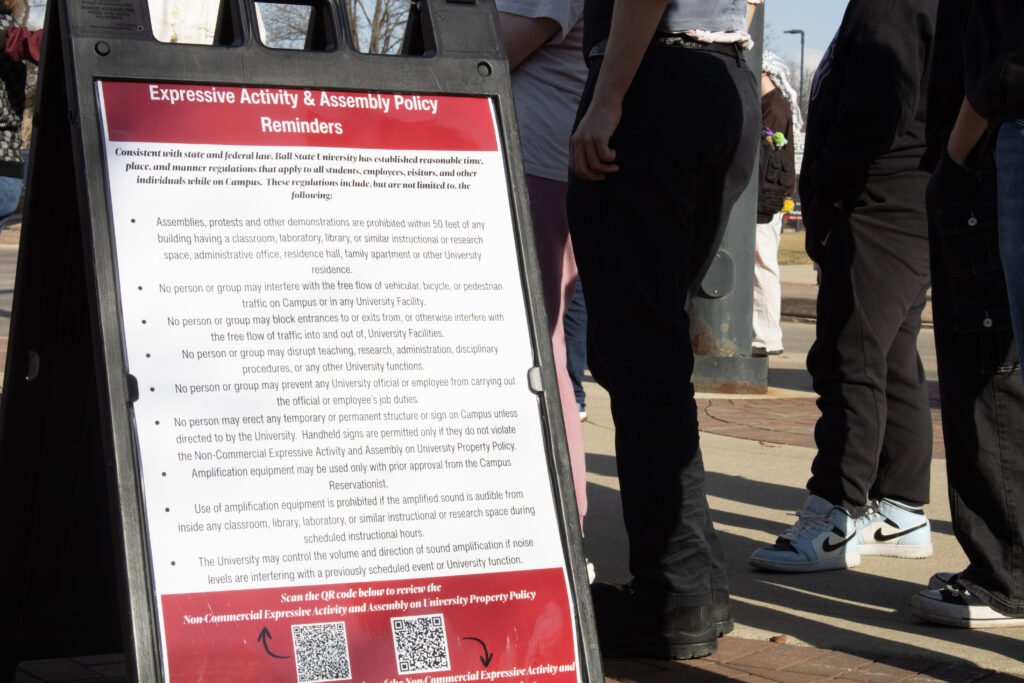
A sign set up at the Scramble Light explaining Ball State’s Non-Commercial Expressive Activity and Assembly Policy. The sign was placed at the Scramble Light hours before a protest on Feb. 18, 2026 was scheduled to occur. (Ransom True)
MUNCIE, Ind. — On Nov. 19, more than a dozen Ball State University students entered the Frank A. Bracken Administration Building to leave notes with the secretary of the President, Geoffrey Mearns. Twenty days later, Ball State student Cooper Archer received a letter claiming he violated multiple campus policies, violations that would ultimately result in him being suspended from classes and trespassed.
The notes addressed students’ concerns, including the university’s investment in companies that they state “fund the genocide in Gaza” and the potential presence of Immigration and Customs Enforcement officers on campus, but the doors to the president’s office were locked at approximately 4:45 p.m., when they came to leave their notes. One of the students, Stella Allen, shared a video she took on her phone that shows her confused peers looking into the office. They were asking each other why the doors might be locked, remarking they couldn’t see anyone inside.
The video then shows Vice President of Student Affairs Ro-Anne Royer Engle descend the stairs and ask the students to leave the building. The students asked her why they were being asked to leave a public space. After several minutes of back and forth with Royer Engle, she provided a specific reason for her request that they leave: “Time, place, and manner section, section 3,” she told the students.
She is referring to the university’s Non-Commercial Expressive Activity and Assembly on University Property policy, where Section 3 outlines Ball State’s regulations about the time, place and manner of protests, assemblies and demonstrations. The video concludes with the students leaving the building at 5 p.m., when the building closes.
Allen reflected on the experience: “[Royer Engels] is like, ‘Okay, fine, you have the right to be here as a student.’ She admits that, and then gets us paper and pens. We write notes and then give them to her. Then, it’s 5 o’clock, and we leave.”
From Leaving Notes to Receiving Letters
On Dec. 9, Archer received a letter stating that he was charged with the following three violations of the Code of Student Rights and Responsibilities: failure to comply, disorderly conduct and other conduct violations for his actions on Nov. 19.
Archer explained his understanding of the “Other Conduct Violations,” as described in the letter: “They said what we were doing was a protest, and because that protest was within fifty feet of a building, we violated that policy.” The students did protest after they left the building, but Archer said they ensured to set up fifty feet from the building.
In the subsequent nine days, Archer was suspended from classes until after May 8, lost his on-campus job as an archaeological technician and was trespassed from campus grounds.
The eleven other students also received similar letters to Archer and due to their lack of prior offenses, after being seen before a University Review Board, were placed on conduct probation, mandated to do 10 hours of community service and to write a 1,500-word reflection paper.
An appeal of these charges resulted in nine of the students having their disorderly conduct charges dropped, which removed their mandated ten hours of community service.
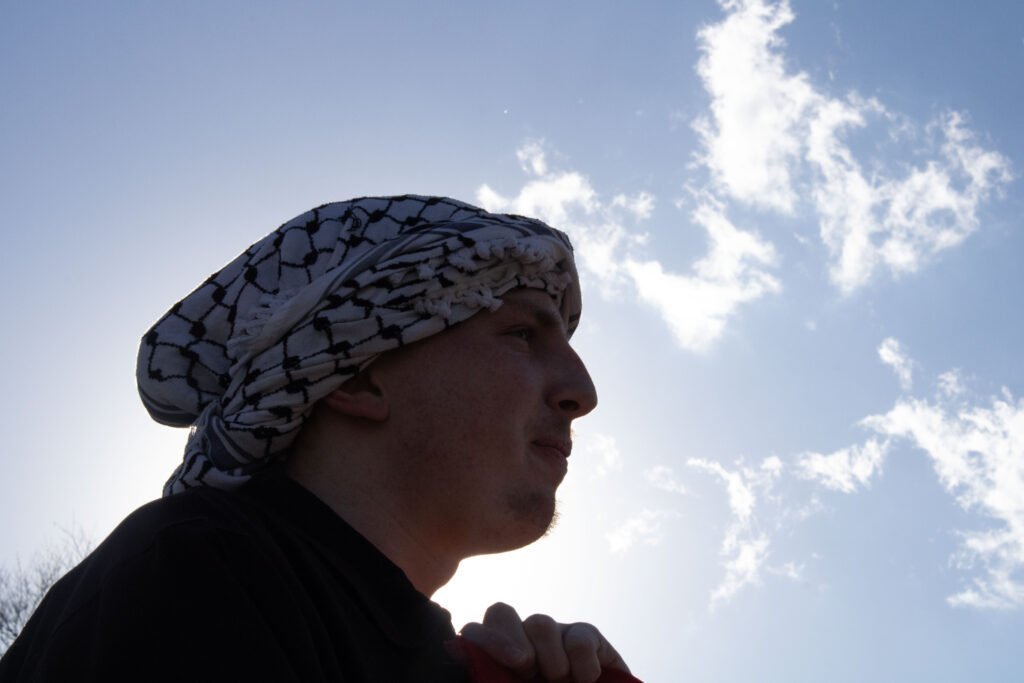
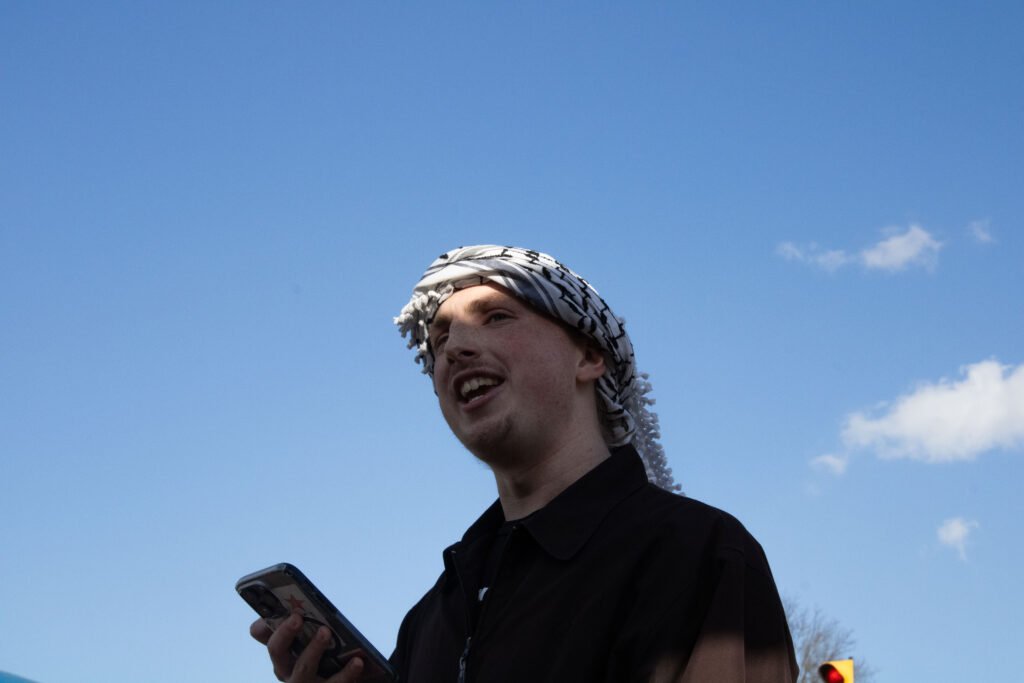
Cooper Archer participates in a protest at the Scramble Light on Feb. 18, 2026. The gathering was in response to the twelve sanctioned students. (Ransom True)
The First Offense
Archer’s sanctions were unique, as he was the only student of the twelve involved to receive a suspension. He said his punishment was harsher because of an incident in February 2025, when he and four of his peers were arrested for speaking out of turn at a Ball State Board of Trustees meeting at the campus’ L.A. Pittenger Student Center. Archer said the “Ball State 5” were not given a reason when they were removed from the meeting.
“They arrested us without any real thought,” Archer states that he was informed by his arresting officer that he was detained and escorted out of the building. “As soon as [we’re] taken out, [we’re] put in handcuffs and taken to the police station,” he said, reflecting on his arrest.
After a quiet ride in the back of a squad car, Archer was placed in a jail cell alone for several hours. Later, Archer learned he was charged with two counts of disorderly conduct, which was later acquitted on Nov. 21, 2025, by Judge Thomas A. Cannon Jr., who said as the trial was concluding, “Evidence of mere annoyance is not sufficient.”
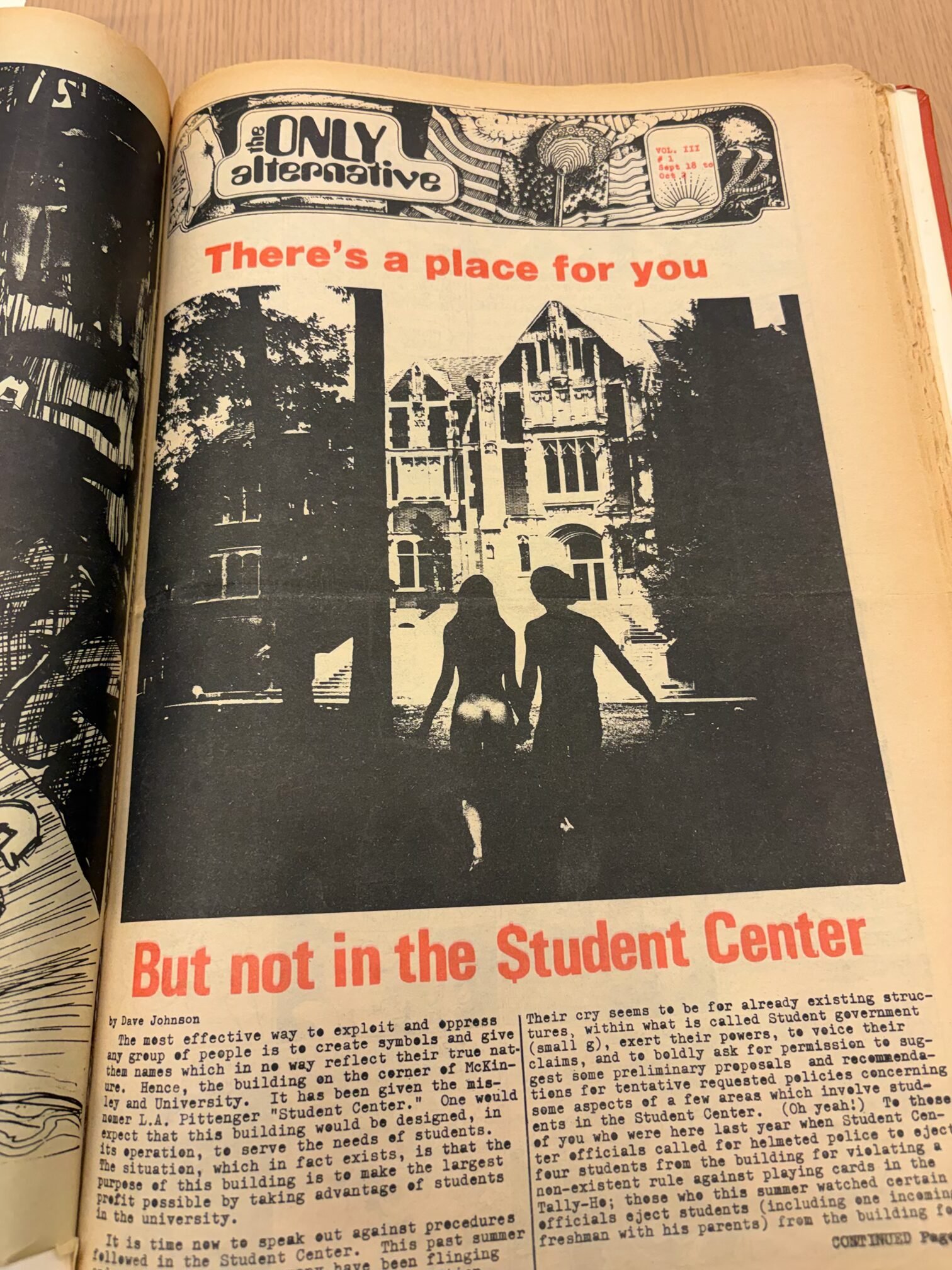
It is not the first time Ball State has disciplined students for actions on campus. An underground student newspaper, The Only Alternative (1969-1971), published an article titled, “There’s a place for you But not in the $tudent Center,” which describes how “helmeted police” removed students for violating a policy against playing cards in the Tally-Ho, a former cafeteria in the Student Center.1 The newspaper wrote that it could not find any policy listed that warranted removal, especially for playing cards.
Despite his acquittal, Archer said he was placed on conduct probation for disorderly conduct, because he interrupted the February Board of Trustees meeting. So, already being on conduct probation prior to the events of Nov. 19, the University Review Board opted to suspend Archer, who said his appeal on this decision was denied.
This result confused Archer, who said, “I will say I’ve gone to that office and left notes for the president before. It’s a thing people do, it’s a public building, people are expected to go there.”
In the video Allen took on Nov. 19 , in which Royer Engel said “Yes, you are allowed to be in this building as students,” before mentioning the Non-Commercial Expressive Activity and Assembly policy.

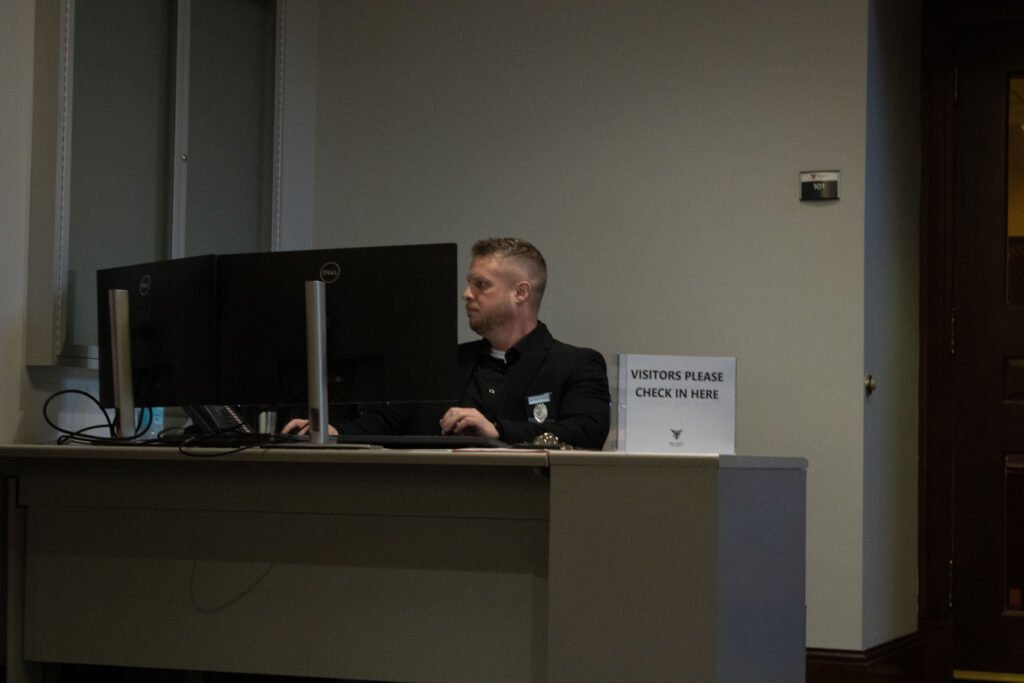
A University police officer operates a security desk outside the Office of the President. The desk was placed there after the events of Nov. 19, now requiring guests to sign in at the desk before visiting. (Ransom True)
Fifty-Foot Concerns
Prior to Archer’s suspension, he prided himself on his on-campus involvement with an (unofficial) student organization, Muncie’s chapter of the Students for Justice in Palestine. Archer’s involvement in SJP included organizing meetings, rallies and protests to put pressure on the Ball State’s administration to divest from the genocide in Gaza.
While concerned about his own well-being, Archer is focused on his fellow activists: “I think the precedent that sets, I mean you can define anything as a protest, really. You can ask an unfavorable question or wearing a provocative t-shirt. What they’re saying is any type of behavior like that that takes place within 50 feet of a building is sanctionable.”
Archer’s concerns are backed up by the university’s actions. Alex Bordenkecher, another student associated with the SJP, left his dorm on Dec. 7 and unknowingly engaged in an act of protest. Facing a conduct hearing already for leaving a note on Nov. 19, Bordenkecher explained his, now, second conduct hearing this semester while stifling a smirk.
“In the snow outside Bracken House I wrote ‘Free Palestine’ and ‘Divest’ and I guess the ‘Divest’ was within 50 feet of the building,” he said, “and writing in the snow qualifies as a protest, and I’m in trouble for it.”
Bordenkecher then explains that he was provided the evidence for this accusation, a collection of security camera footage following him writing in the snow and then walking from Bracken House to his dorm. Although, unlike Archer, this second conduct hearing did not end in suspension. Instead, he faces an official warning from Ball State, though an email cited a different policy violation than he initially was informed of. The email states that Bordenkecher “accessed a non-public area without authorization.”
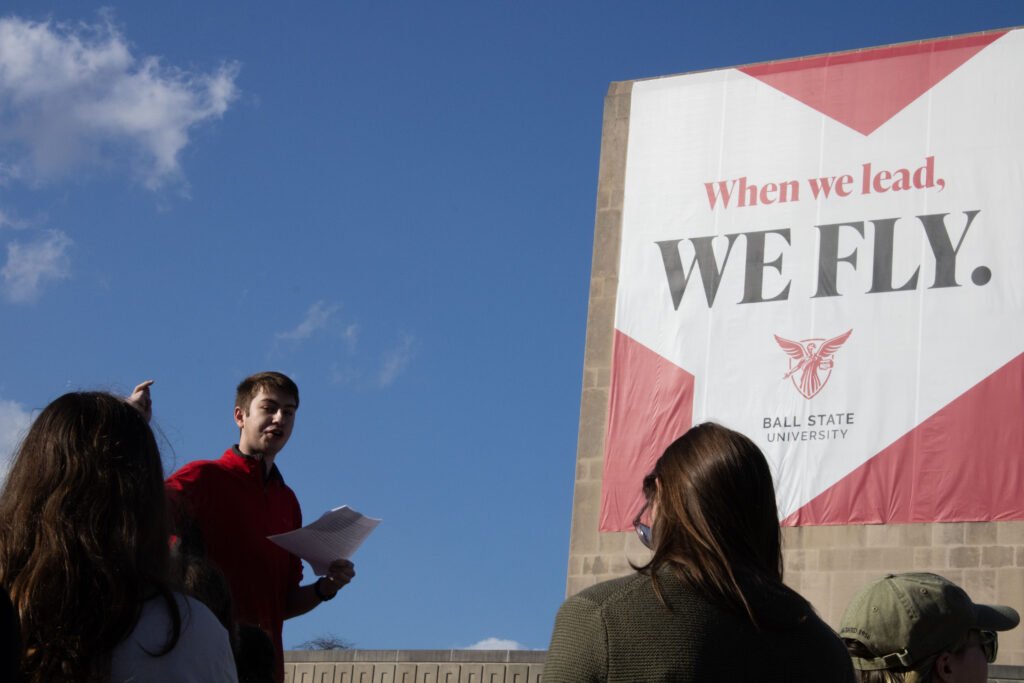

Alex Bordenkecher leads a speech during a protest at the Scramble Light on Feb. 18, 2026. (Ransom True)
A Student of History
Archer was also pursuing a bachelor’s in history before his suspension, which he said informed his work with SJP.
“Every single time [students] have been retaliated against, in the end, they are the ones who are remembered in the history books, they are the ones that are exonerated. Not the prosecutors, not the presidents, but the people,” Archer said.
In the meantime, Archer still educates himself. Surrounded by peers, he often engages in and leads community reading groups at the Muncie Liberation Studio, where the group reads selected texts out loud and discusses their importance.
A reading group every day of the week still won’t save Archer from his current fate though, as he exclaimed prior to one of these reading groups: “Of course I’m bored, I don’t have a job!”
The students punished for the events of Nov. 19 have not sat idly by and taken what they see as unjust punishment. On Jan. 29, President Mearns was addressed a letter from the Foundation for Individual Rights and Expression that stated:
“In addition to rescinding or dropping these students’ sanctions, FIRE urges Ball State to amend its policies to provide students and the URB greater clarity as to what conduct is prohibited by the Non-Commercial Expressive Activity and Assembly policy and the Code of Student Rights and Responsibility.”
The university did not respond to FIRE’s letter by their Feb. 15 deadline, but life continues for the affected students.
These concerns did not fall on deaf ears either, as the ACLU announced on March 2 that a federal lawsuit was filed seeking to sue Ball State for the sanctions put onto Archer. The ACLU’s press release outlines that the suit seeks to challenge the university’s rules barring protest within fifty feet of a building and that students must “comply with directives from university officials,” stating these were violations of the students’ First Amendment rights.
A similar suit has been filed with ten of the other sanctioned students as the plaintiffs.
While Archer’s life plan won’t stay the same, he said the disruption is nothing like that of the Palestinians he advocates for.
“What I’m going through right now is nothing compared to what the people I’m advocating for are going through,” he said. “What I’ve gone through isn’t even a drop in the bucket for the types of pain these people have suffered. Nothing you can sacrifice here is as big or even close to as big as the sacrifice the people of Gaza have been going through for 70 years.”
Multiple Ball State administrators declined a request for comment despite Archer filling out a Third Party Disclosure Form, allowing the administrators to discuss the details of Archer’s case otherwise protected by FERPA.
Notes:
1. “There’s a place for you But not in the Student Center.” The Only Alternative. Vol. III # 1 Sept. 18- Oct. 2. https://archivessearch.bsu.edu/repositories/4/resources/2012 (image here)