
After Pressure, Council Introduces Transparency Ordinance Unanimously
1.9.2026 / News / Daisy Dale
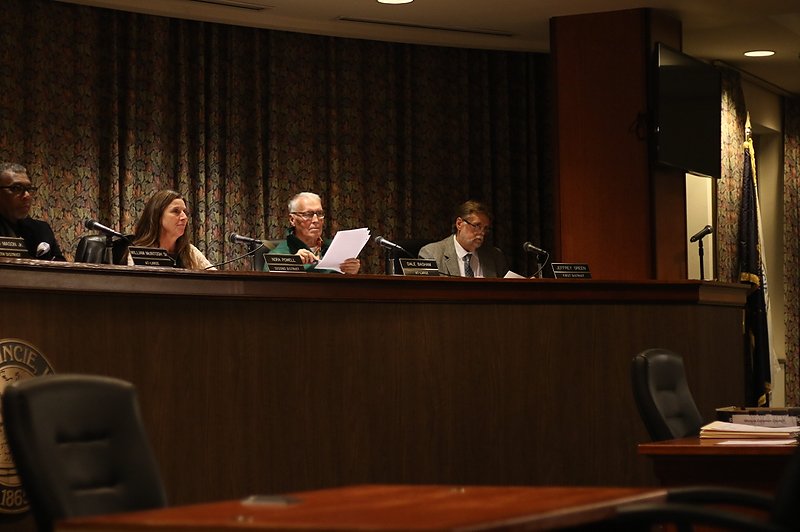
Photo from November, 2025.
MUNCIE, Ind. — At the first Muncie City Council meeting of the year, Ordinance 3-26, sponsored by Nora Powell, was passed 9-0 for introduction. Local advocacy group Muncie Resists led the charge to champion the refiling of a previous ordinance, Ordinance 40-25, to ensured that future agenda items for council are properly filed either by a council member or legal counsel.
The original ordinance was created after Mayor Dan Ridenour’s Executive Assistant, Shareen Wagley, filed a resolution in October without its sponsor, Dale Basham, signing onto it. Resolution 17-25, a resolution on the financing of rebuilding Fire Station 5 which appeared on October 6, was identical to Resolution 16-25 that was withdrawn by its sponsor Dale Basham in their meeting the month prior. Basham at the October meeting was asked by another council member, William “Billy” McIntosh, about why it had reappeared at that meeting. Basham told McIntosh and the crowd that it was refiled without his knowledge and that he didn’t sign Res. 17-25. The signature on the document was the same one used from the previous resolution.
After the fact, council member Nora Powell decided to sponsor Ord. 40-25 that would have changed prerequisites in city code to ensure the mistake wouldn’t happen again. As council’s then-attorney Dan Gibson explained, it would ensure that future ordinances and resolutions would be properly filed either by a council member or legal counsel, and therefore ensuring that signatures are valid from there on. Ord. 40-25 was voted down 5-4, along party lines with Republicans voting against and Democrats voting in favor.
On Monday night, just over a dozen residents spoke out in favor of Ord. 3-26, largely with the sentiment that transparency should be a priority. Vice chair of Muncie Resists Mary Moore received possibly the most applause of anybody when she spoke about the importance of putting party politics aside. Moore stated “I think it’s important to note that this council has a track record of voting along party lines. Unfortunately even on matters that are procedural rather than political. When votes consistently divide that way it creates the impression that decisions here are made more by party loyalty than by the merits of the issue itself. A perception that can easy weaken public confidence and the council’s independence.” John West, who that night was reappointed by council to the Muncie Land Bank, called the ordinance a “no-brainer.”
Prior to the 9-0 vote, council made some surprising appointments to several different boards. In the middle of last year two members, Jerry Dishman and Brandon Garrett, switched political affiliation from Democrat to Republican and thereby made council majority Republican by 5-4. While the council reorganized on Monday to have their leadership be Republican, a few of their board appointments raised some eyebrows. For the Muncie Redevelopment Commission council reappointed Zane Bishop, who was first appointed when council was majority Democrat, and for their second appointment added Seth Rawlings, a Democrat.
While Brandon Garrett and Harold Mason, both council members, were nominated for the Emergency Communications Board, Garrett oddly voted against himself despite being nominated and giving Mason the position by a 5-4 vote. Garrett did not explain his reasoning.
For the Muncie Land Bank, council reappointed Brad King, Rebekah Hanna, and John West. Republican Ro Selvey told the Post-Democrat “I know each individual on the Land Bank and believe in their mission and purpose. Reappointing the three members will only help move the Land Bank forward into greater things.” Early last year many were shocked when Mayor Dan Ridenour appointed both Ryan Webb and himself to the Land Bank, leaving many to see it as a partisan act on the part of the mayor.
In addition, council’s new president, Jeff Green, announced changes to how the public comment portion of meetings would be handled. Taking effect at the next meeting Feb. 2, the changes include limiting each person’s time to two minutes, requiring speakers sign up before the meeting, having the public comment portion take place before agenda items instead of after the fact, and requiring every speaker’s home address be stated. Along with these changes, there will no longer be comments from the audience for ordinances that are introduced, and instead only if they are up for adoption.