
Ball State's Latest Repression
1.20.2026 / Op-Ed / Alex Bordenkecher
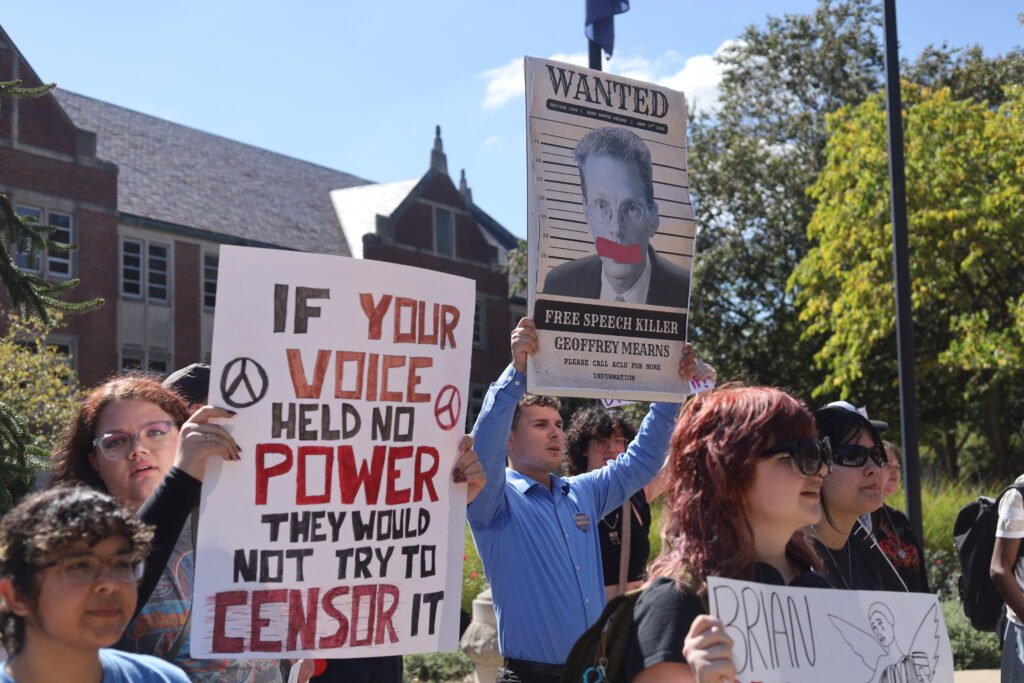
For over two years, Ball State University has run cover for and funded Israel in its genocide against the Palestinian people in Gaza. For just as long, students of Ball State have fought to bring forth a popular university, where students control the university they pay for and keep their money out of the war machine. The University has met students’ efforts with apathy at best and open repression at worst.
After months of protesting, calling, and emailing with no response, the Muncie chapter of Students for Justice in Palestine (SJP) began a hunger strike on November 5th with simple demands: Meet with Students for Justice in Palestine; immediately divest from Israel and the genocide its committing; make Ball State’s investment portfolio public; end all impediments on free speech; and terminate the employments of University Police Officer Michael Conner and Board of Trustee Vice Chair Brian Gallagher.
In response to being ignored, about a dozen students went to the Administration Building on November 12th to leave a letter for President Mearns. As soon as they entered, every office in the Admin Building was locked up tight. The students were peaceful, quiet while indoors, and did not disrupt regular business. Despite this, they were told to leave by Vice President of Student Affairs, Ro-Anne Royer Engle. They asked her to cite the policy they were allegedly violating. After all, they were only students trying to leave a letter to their president in a public building during business hours. Not only did Engle refuse to cite a policy, but she threatened to call the police if they didn’t leave. The students knew she wasn’t bluffing, as Ball State Police have arrested protesters without cause in the past as in the cases of the Ball State Five. Engle eventually did call the police. As the students departed, she could be heard saying on the phone, “Never mind, they’re leaving.”
November 19th marked fourteen days into the hunger strike, and the University still refused to even directly acknowledge SJP. So, students returned to the Admin Building— once again trying to leave letters for their president. The administration once again violated the students’ rights and attempted to lock them out of the entire Admin Building. They weren’t quick enough however, and the students entered despite the Administration’s best efforts. Once again, the students found all the offices inside, including the Office of the President, locked up tight.
Engle returned, along with Tiffany Peters, Assistant Vice President for Student Affairs, who again told the students to leave. The students declined. Like the week prior, they asked the administrators to cite what policy they were supposedly violating by entering a public building, which they pay for, during business hours. Engle claimed they were disrupting business, but there couldn’t have been much business happening since every office was shut down as the students entered. Keep in mind, students leaving a letter with a secretary is routine business at an administrative office.
Defeated, Engle conceded and passed out paper so the students could write their letters. As they did, one student, on his third day of the hunger strike, became so dizzy he was unable to stand and collapsed in the lobby of the Admin Building. The administrators did nothing as other students got him food and water. Several minutes later, after the student already had others looking after him, Engle finally asked if he wanted them to call EMS, which he declined. At 5 o’clock, the Admin Building began to close and students were told to exit, and they complied. The next day, the same student was struck by another bout of dizziness and weakness and had to be taken to Ball Memorial Hospital.
On the evening of Monday, December 1st, a week and half after delivering their letters, twelve students received emails from Kaleigh Richardson, Director of the Office of Student Conduct. They were accused of “Disorderly Conduct,” “Obstruction or Disruption,” and vaguely tacked onto the end, “Other Policy Violations,” all for simply trying to leave letters to their president expressing opposition to their tuition funding a genocide.
Four students had their preliminary meetings on Thursday, the 4th; the other eight on Friday the 5th. It was now the week before finals, and instead of studying, these twelve students were being dragged down to the Office of Student Conduct to give their testimonies.
On Friday, the same student who collapsed in the Admin Building collapsed again during his preliminary meeting. Two students, at the Conduct Office to show support and solidarity, had to physically carry him out of the conference room while Richardson did nothing. Students set him on a waiting room couch, got him some water, and started discussing where they should take him and who they should call. In a vain attempt of support, Richardson asked if they wanted her to call EMS. “Are you going to pay for it?” the students asked. Richardson didn’t answer. The students ultimately called a friend with a car to take him to Ball Memorial Hospital.
Before the student who collapsed had even left the waiting room, Richardson turned to the next person scheduled and called them into the meeting room. Richardson’s primary concern was getting her meetings done, not with the health and safety of her students. The student who collapsed spent yet another afternoon and evening in Ball Memorial Hospital.
That final student, called in while the other was nearly passed out, went into their meeting. They expressed such fear and concern about President Mearn’s promise to comply with ICE that Kaleigh Richardson was nearly brought to tears. Despite the pull of her conscience, on Tuesday, December 9th, all twelve students were officially charged with “Disorderly Conduct,” “Failure to Comply, ” and the vague “Other Policy Violations.” If found responsible, eleven out of twelve students would be sentenced with twenty hours of Community Service and a full calendar year on Conduct Probation—the longest “usually” given.
To crush further dissent, Ball State selected one student to make an example out of. Cooper Archer is in his third year protesting Ball State’s sins. Out of the twelve students charged for leaving letters, who were all charged with the same policy violations, he is the only one to face suspension.
His trial before the University Review Board was held on December 18th. The Review Board was made up of Richardson acting as the prosecutor, T.J. Brecciaroli acting as the non-voting Hearing Chairperson, and two administrators and one Student Government Association representative presiding with voting powers. These final three are the ones to make the decision. However, every single person on the Review Board is selected in some part by the prosecutor, Kaleigh Richardson.
Brecciaroli is the Associate Vice President for Student Affairs and Dean of Students, which means Ro-Anne Royer Engle is his direct superior. He could not impartially conduct a trial, as his boss was present when the supposed conduct violations took place and filed the report with the Office of Student Conduct. Furthermore, the administrators on the review board “are selected by OSC and confirmed by the Student Government Association,” according to the Code of Student Rights and Responsibilities. The SGA representative is “recruited and selected in conjunction with the [Office of Student Conduct]” of which Richardson is the director.
The conflicts of interest on display here are staggering. The prosecutor of this case, and all serious conduct cases at Ball State, had a hand in selecting both the judge and jury presiding over the trial. With the deck stacked against him, it’s no surprise that Archer was ultimately suspended.
Despite its supposed dedication to “Beneficence,” the Ball State Administration displays a complete lack of moral backbone. The repression of the past two months is nothing new. In February of 2025, four students and an alum, known as the Ball State Five, were unlawfully arrested and jailed for protesting at a Board of Trustees meeting. Two weeks later, one of these students lost her housing and job as an RA without being found guilty of any crime, and was given one week to find another place to live or be made homeless. Only one of the Ball State Five’s cases ever went to trial, the other four were thrown out after a judge ruled that the arrests were unlawful and a violation of the Ball State Five’s First Amendment rights. Despite losing in court, Ball State continues to disregard students’ right to free speech and the rights enshrined in their own “Freedom of Expression Statement,” an article that firmly commits the University to “the principle that debate or deliberation may not be suppressed…” and should provide all members of the University “the broadest possible latitude to speak…” The hypocrisy in these words hardly seems worth mentioning. Furthermore, Ball State University is a public school receiving public funding and has an even greater commitment to protecting students’ constitutional rights.
It is crucial to remember why those students went to speak with their President on November 19th. After more than two years of livestreamed genocide, Ball State remains invested in Israel. President Mearns continues to downplay the death count and lock down his office when students come to voice their concern. The Administration would rather let their students starve themselves for three weeks than stop profiting off of the bloodshed in Gaza. When students’ voices become too great to ignore, the administrators call the police, bury them in conduct charges, and kick them out of their housing and school community. Student activists show the only Beneficence at Ball State. The University displays only cowardice, greed, and total moral depravity.